The AI Reckoning: Civilization’s Great Disruption
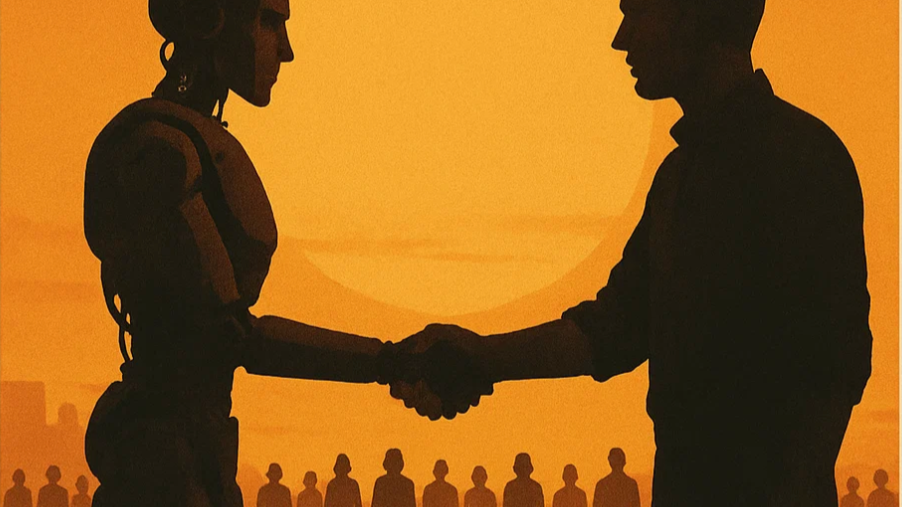
We face with grim inevitability the specter of artificial intelligence descending upon global labor markets—a revolution wielding algorithmic precision like some merciless digital scythe. The professional classes of the West—those comfortably ensconced in climate-controlled offices, diligently parsing spreadsheets and drafting memos—are awakening to their own obsolescence. Machines require no benefits, demand no raises, and outperform their human counterparts with ruthless efficiency. The redundancy is not coming; it has arrived.
The West’s Cognitive Collapse
Goldman Sachs estimates 300 million full-time jobs may vanish to automation, while McKinsey’s sobering 2017 projection reaches a staggering 800 million by 2030. The professions we once considered sacrosanct—law, finance, even medicine—now face existential threats. Why employ junior associates when AI reviews contracts in seconds? Why retain analysts when algorithms predict markets with superior accuracy?
The irony stings: the same elites who offshored manufacturing now face their own displacement. At least factory workers could transition to service roles. But what refuge remains when chatbots handle customer service, and virtual assistants outperform call centers?
The Developing World’s Impossible Position
For decades, nations like India and the Philippines built economies on Western outsourcing. Now AI erases their competitive advantage overnight—no accent too nuanced, no time zone inconvenient. Consider India’s millions of aspiring professionals: what becomes of them when coding assistants render engineers redundant and customer service bots undercut human operators?
China’s manufacturing dominance already teeters under automation’s advance; its white-collar workforce faces similar disruption. Even Africa and South America, having missed earlier industrial waves, now confront a future where manual trades may be their only economic lifeline—assuming infrastructure exists to support them.
Governance in the Post-Labor Era
This crisis demands we ask: which systems might survive? Ideologues will peddle their usual remedies—socialist collectivization, libertarian markets, technocratic management—but past paradigms may prove inadequate for this unprecedented disruption.
Socialism’s Siren Song—And Its Pitfalls
The socialist, smelling blood in the water, will declare this the moment for the state to seize the means of (AI) production. And indeed, if any system is theoretically equipped to manage mass job displacement, it is one built on redistribution. A state that controls the AI golden goose could, in theory, spread its eggs equitably—funding universal basic incomes, free education, and public works.
But history whispers a caution. Centralized control of technology has a habit of stifling the very innovation that makes abundance possible. The Soviet Union, for all its five-year plans, could not keep pace with Silicon Valley. Worse, socialist regimes have a dismal record of allocating not just resources but meaning—replacing the dignity of work with the despair of dependency. And let us not forget that AI, in the hands of an omnipotent state, could enable surveillance and control beyond Orwell’s nightmares.
The Nordic Third Way—Or a Global Dead End?
The social democracies of Scandinavia offer a tantalizing middle path: market-driven innovation with robust safety nets. Could this model scale globally? Perhaps—if every nation had Norway’s oil wealth or Sweden’s homogenous society. But the developing world, already facing existential threats from AI-driven outsourcing, lacks the fiscal capacity for such generosity. And even the Nordics rely on taxing high-earning humans; what happens when most of those humans are obsolete?
The Techno-Feudal Future
Absent a radical reinvention, we may drift toward a neo-medieval order: a handful of AI-wielding elites (corporate or governmental), a priestly class of engineers and creatives, and a vast serfdom of the economically superfluous. Capitalism, socialism, democracy—all may buckle under the weight of populations with nothing to sell but their attention or their compliance.
A Path Forward
Our window for adaptation narrows daily. The systems that will survive aren’t those clinging to dogma, but those embracing pragmatic synthesis:
- Preserving market dynamism to drive innovation
- Implementing radical redistribution mechanisms (data dividends, sovereign AI funds)
- Redefining “work” beyond wage slavery
- Investing in uniquely human capacities—creativity, care, craftsmanship
The Star Trek vision—where abundance frees humanity for higher pursuits—remains tantalizing but distant. Between here and there lies either societal reinvention or collapse. The choice before us isn’t between systems of the past, but between forging a new civilizational contract or facing irrelevance.
The Final Wave: When Robots Claim the Physical World
The cognitive disruption was merely the first wave—AI came for our spreadsheets, our contracts, our diagnoses. Now, the second tsunami approaches: robotics, advancing at comparable speed, poised to seize the remaining bastion of human employment—physical labor.
The same exponential curves that gave us ChatGPT are propelling robot dexterity toward human-level capability in manufacturing, agriculture, construction, and even complex trades like electrical work and plumbing. Boston Dynamics’ humanoids now perform warehouse tasks; robotic arms install drywall with millimeter precision; autonomous tractors plow fields without a farmer present.
This isn’t some distant sci-fi scenario—deployment is accelerating now. When combined with AI’s decision-making prowess, these machines won’t just replace manual labor, but outperform it: working tirelessly, requiring no breaks, and improving continuously through machine learning.
The brutal calculus suggests that between AI conquering cognitive work and robots claiming physical tasks, we may soon confront an economy with shockingly few domains where human workers hold any competitive advantage at all. The time to prepare for this dual disruption is not tomorrow—it’s already here.
The End of Work and the Birth of a New Covenant
The social contract that has governed civilization since the first plow broke earth—work hard, earn your keep—is unraveling before our eyes. When both mind and muscle are automated, when algorithms outthink and robots outwork us, we face an existential question: in a world without jobs, how shall we live?
We find ourselves at the Rubicon of post-labor civilization, where the catechism of toil and reward—that Puritanical bargain which sustained Western man since the dawn of industrialization—crumbles before our astonished eyes. The answer, my dear besieged contemporaries, demands nothing less than the wholesale demolition and reconstruction of our societal edifice.
Consider the delicious paradox: these very machines that threaten to render human effort superfluous may simultaneously engineer our salvation. Should AI and its mechanical progeny drive production costs toward asymptotic zero—should the alchemy of automation transmute scarcity into abundance—we may yet witness the most extraordinary redefinition of rights since the Enlightenment. Shelter and sustenance, those ancient preoccupations of mankind, could cease being economic variables and become instead civilizational constants, as universally accessible as oxygen.
Yet here lies the existential quandary: man does not live by bread alone. We must—with all deliberate urgency—conceive new vessels for purpose beyond the paycheck, new metrics of value untethered from labor, new wellsprings of dignity independent of employment. The challenge before us is not technological but philosophical—nothing less than determining what it means to be human when the defining struggle for survival is outsourced to silicon and steel.
Either we construct a new covenant where technology’s bounty is shared by all—not hoarded by the architects of these disruptions—or we descend into an age of unrest unlike any in history. The choice is between collective flourishing or dystopian collapse. The time to decide is now, before the machines finish writing our future for us.
—BOK
A short list of the potential jobs to be displaced by AI:
Professional Services: 1.Paralegals/legal assistants 2. Contract review attorneys 3. Patent clerks 4. Compliance officers 5. Tax preparers 6. Accountants (especially routine bookkeeping) 7. Auditors 8. Management consultants (for routine analysis)
Finance: 9. Investment analysts 10. Loan underwriters 11. Claims adjusters (insurance) 12. Financial advisors (robo-advisors) 13. Mortgage brokers 14. Credit analysts 15. Actuaries 16. Back-office banking operations
Healthcare: 17. Medical transcriptionists 18. Radiologists (image analysis) 19. Pathologists (lab analysis) 20. Pharmacy technicians 21. Medical billing specialists 22. Health insurance processors 23. Diagnostic support staff
Creative Industries: 24. Content writers (SEO, marketing copy) 25. Technical writers 26. Localization translators 27. Graphic designers (template-based work) 28. Stock photographers 29. Music composers (production music) 30. Video editors (routine editing)
Technology: 31. Junior programmers 32. QA testers 33. Data entry specialists 34. System administrators (routine maintenance) 35. Network monitoring technicians 36. Technical support (Tier 1) 37. Data analysts 38. Cybersecurity analysts (routine monitoring)
Customer Service: 39. Call center operators 40. Chat support agents 41. Hotel/reservation clerks 42. Basic sales representatives 43. Telemarketers 44. Customer success managers (routine queries)
Education: 45. Online tutors (standardized subjects) 46. Graders/assessment specialists 47. Language teachers (for practice/drills) 48. Instructional designers (template content)
Administrative: 49. Executive assistants 50. Scheduling coordinators 51. Data entry clerks 52. HR benefits administrators 53. Payroll specialists 54. Meeting notetakers 55. Travel arrangers
Manufacturing/Logistics: 56. Inventory managers 57. Supply chain analysts 58. Quality control inspectors 59. Warehouse supervisors 60. Logistics planners 61. Procurement specialists
Media/Journalism: 62. Sports/news reporters (routine events) 63. Financial earnings reporters 64. Local news writers 65. Content moderators 66. Fact-checkers 67. Social media managers
Other Professional: 68. Real estate appraisers 69. Survey researchers 70. Market research analysts 71. Recruiters (initial screening) 72. Interpreters (for common languages) 73. Architects (routine designs) 74. Appraisers/assessors
Emerging Threats: 75. Therapists (chatbot-based CBT) 76. Life coaches 77. Personal stylists (AI recommendations) 78. Nutritionists (algorithmic meal plans) 79. Legal mediators (routine disputes) 80. Policy analysts (data-driven aspects)
Leave a Reply